Hope rebuilds the ruins of Jerusalem. The Jewish people kept hope alive and hope kept the Jewish people alive. That, I think, is the message of Tisha B’Av.”
— Rabbi Lord Jonathan Sacks, z”l
I am a native-born, fourth-generation Israeli, and I have walked every corner of our beautiful country. And yet, every time, I am moved anew when I see my homeland’s beauty reflected in the eyes of visitors.
Earlier this month, I was given that gift again. And, as always, I fell in love—with my home and the people who make it what it is.
JCC Association leaders made a courageous choice in moving forward with the JCC Movement Leadership Experience in Israel despite the war clouds that still haven’t parted. When we began planning, we had hoped that by summer, when the group would arrive, we would find an Israel already shedding the weight of war and stepping into a season of renewal. But reality, as it often does, had other plans.
Even so, we chose not to focus only on grief and loss. We chose to show things as they are: a mix of crisis and growth, an unlikely combination that is nonetheless entirely true—the ache of memory living alongside the pulse of hope.
All week, moments of light broke through the darkness of the 1,000 days since our world changed. Again and again, salty tears of grief mixed with sweet tears of pride.
We met bereaved parents. Tami, who lost her daughter, Niv, and Niv’s partner, Nirel, founded a trauma center in their memory. Sigal, who lost both her daughters, Norelle and Roya, still signs every message “Sigal, always a mother of three,” though only one son remains alive. She has since built memorial projects under one name: There Is No End to Your Light.
Two mothers, each carrying unimaginable loss, who choose to honor their daughters by keeping their light alive in the world. In that light, they find the strength to rise each morning into a world their daughters no longer inhabit, but still fill with acts of goodness in their names.
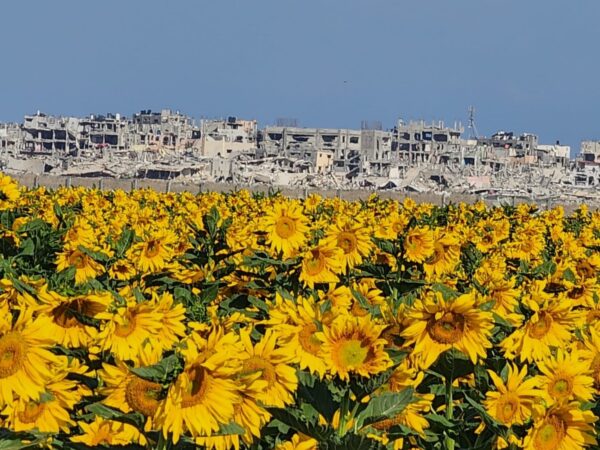
We met Moran, a farmer from Kibbutz Nachal Oz near the Gaza border. Deeply rooted in the land, he believes the answer to destruction is to build, and the answer to loss is to plant and grow. Together with friends and with help from others, Moran is helping the fields of the western Negev—land soaked in the blood of the 1,200 murdered on October 7 and the grief of the widows and orphans they left behind—bloom with new life. Every morning, he wakes to see Gaza just beyond his window and to hear the sound of distant artillery. And still, he holds one unshaken belief: This land, renewing itself, will yield more than it ever has before.
We met Rabbi Menachem Bombach—a Haredi rabbi who, in these difficult days of division, has chosen to build bridges. A graduate of the Haredi yeshiva world’s top institutions, he enlisted in the army, completed his matriculation independently, pursued academic studies, and founded a growing network of Haredi high schools—for boys and girls alike—that encourages young people to participate in all aspects of Israel’s civic life, including military service and the broader society, all while holding firmly to the traditions of their community. His story reflects something true about Israeli society as a whole: It is a country built on hard work, faith, and determination, comprising many different backgrounds and beliefs, yet held together by a shared purpose: to overcome hardship and loss—and to offer hope.
We spoke with Raz and Ohad Ben Ami, survivors of Hamas captivity, who shared their story: the long separation, the physical and emotional darkness, and their return to life, which they demonstrated by renewing their wedding vows and choosing, again, to smile, to celebrate, to live.
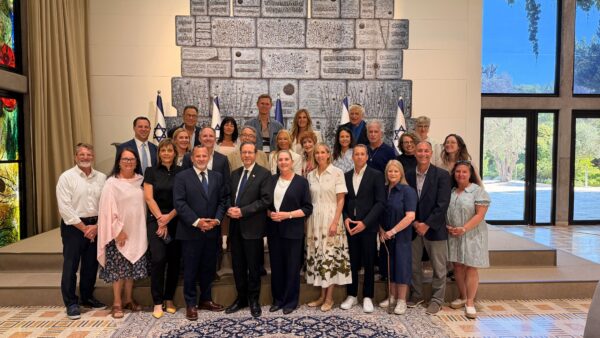
Finally, we met Isaac Herzog, the country’s president, who took real interest in the delegation comprising leaders from Jewish communities across North America and voiced full solidarity with the real threats the communities face, yet always stand proudly beside the State of Israel, homeland to every Jew.
Today marks the beginning of the Hebrew month of Av, a time of mourning for tragedies throughout our history that happened during this month, including the destruction of both the First and Second Holy Temples and the expulsion from Spain in 1492, among others.
The Second Temple was destroyed in the year 70 C.E., after a long period of political and social breakdown marked by a failure of leadership, internal division, and hatred among our own people. Those same fault lines exist today alongside real external threats: Hamas rebuilding its strength in Gaza; Hezbollah refusing to free Lebanon from its grip while continuing to threaten Israel from the north; and Iran, whose actions loom over our future. Yet even amidst our turbulent election season, the most serious, most existential threat we face comes from within. The Temple, a symbol of Jewish sovereignty, could not survive the internal hatred that consumed it, and it fell. And so, we must ask this question: Will we learn from our history and rise from this period united, or will we repeat our ancestors’ mistakes and be pulled apart by division once again?
My beloved country is a magnificent fabric, woven from every color and texture by hard work, faith, and sheer will. Like a warm blanket on a cold night, it holds both a tender softness and a strength that stands against the wind. Patch after patch, uneven and mismatched, entirely unalike, yet stitched together without compromise, toward one purpose: to rise above pain, hardship, and loss to carry hope forward.
Leah Garber is a senior vice president of JCC Association of North America and director of its Center for Israel Engagement in Jerusalem.